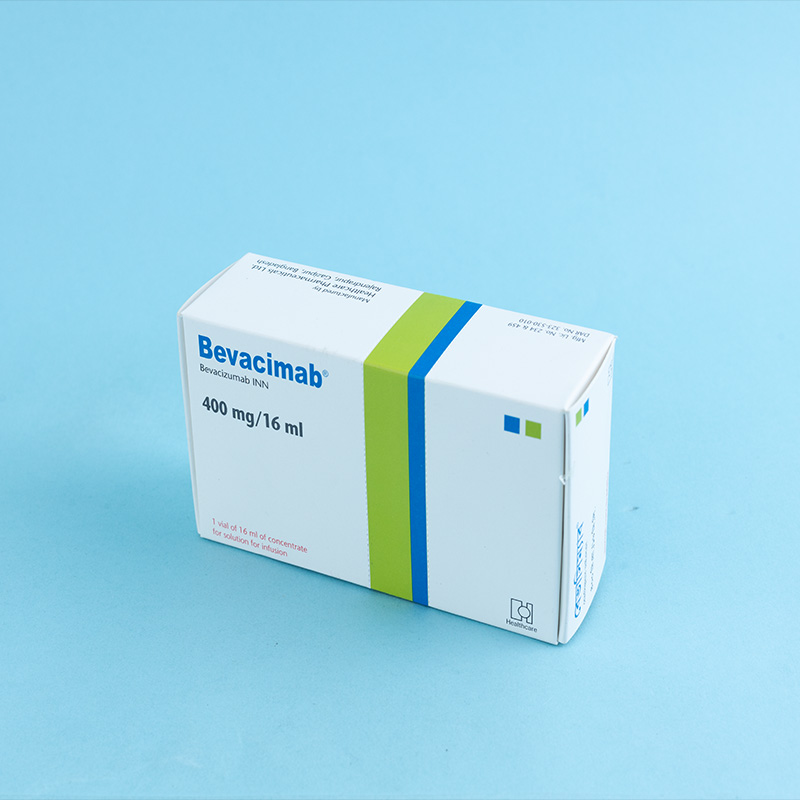
Bevacizumab is a vascular endothelial growth factor-specific
angiogenesis inhibitor indicated for the treatment of:
Metastatic colorectal cancer, in combination with
intravenous 5-fluorouracil–based chemotherapy for first- or second-line
treatment.
Metastatic colorectal cancer, in combination with
fluoropyrimidine-irinotecan or fluoropyrimidine-oxaliplatin-based chemotherapy
for second-line treatment in patients who have progressed on a first-line
Bevacizumab-containing regimen.
Non-squamous non-small cell lung cancer, in combination with
carboplatin and paclitaxel for first-line treatment of unresectable, locally
advanced, recurrent, or metastatic disease.
Glioblastoma, as a single agent for adult patients with
progressive disease following prior therapy. The effectiveness of Bevacizumab
is based on improvement in objective response rate. No data is available
demonstrating improvement in disease-related symptoms or survival.
Metastatic renal cell carcinoma, in combination with
interferon alfa.
Cervical cancer, in combination with paclitaxel and
cisplatin or paclitaxel and topotecan in persistent, recurrent, or metastatic
disease.
Recurrent epithelial ovarian, fallopian tube, or primary
peritoneal cancer:
Platinum-resistant: in combination with paclitaxel,
pegylated liposomal doxorubicin, or topotecan.
Platinum-sensitive: in combination with carboplatin and
paclitaxel or in combination with carboplatin and gemcitabine, followed by
Bevacizumab as a single agent.
Bevacizumab is not indicated for the adjuvant treatment of
colon cancer.
No specific drug-drug interactions are listed. Use with
caution when combined with agents that increase bleeding or impair wound
healing.
Bevacizumab is for intravenous infusion only. Do not
administer as an IV push or bolus. Do not initiate treatment for 28 days
following major surgery until the surgical wound is fully healed.
First infusion: Administer over 90 minutes.
Second infusion: Administer over 60 minutes if the first
infusion is tolerated.
Subsequent infusions: Administer over 30 minutes if the
infusion over 60 minutes is tolerated.
Patients should continue treatment until disease progression
or unacceptable toxicity.
Recommended Doses and Schedules:
Metastatic colorectal cancer (mCRC): 5 mg/kg or 10 mg/kg
every 2 weeks with IV 5-FU-based chemotherapy.
5 mg/kg with bolus-IFL.
10 mg/kg with FOLFOX4.
5 mg/kg every 2 weeks or 7.5 mg/kg every 3 weeks with
fluoropyrimidine-irinotecan or fluoropyrimidine-oxaliplatin-based chemotherapy
in patients who progressed on first-line Bevacizumab.
Non-squamous NSCLC: 15 mg/kg every 3 weeks with carboplatin
and paclitaxel.
Glioblastoma: 10 mg/kg every 2 weeks.
Metastatic renal cell carcinoma: 10 mg/kg every 2 weeks with
interferon alfa.
Cervical cancer: 15 mg/kg every 3 weeks with paclitaxel and
cisplatin or paclitaxel and topotecan.
Platinum-resistant ovarian/fallopian/peritoneal cancer:
10 mg/kg every 2 weeks with paclitaxel, pegylated liposomal
doxorubicin, or weekly topotecan.
15 mg/kg every 3 weeks with 3-weekly topotecan.
Platinum-sensitive ovarian/fallopian/peritoneal cancer:
15 mg/kg every 3 weeks with carboplatin and paclitaxel for
6–8 cycles, followed by Bevacizumab alone until progression.
15 mg/kg every 3 weeks with carboplatin and gemcitabine for
6–10 cycles, followed by Bevacizumab alone until progression.
Preparation: Withdraw the required dose and dilute in 100 mL
of 0.9% Sodium Chloride Injection, USP. Discard any unused portion, as the
product contains no preservatives.
Bevacizumab is contraindicated in patients with:
Hypersensitivity to Bevacizumab or any component of the
formulation.
Unhealed surgical wounds.
Perforation or fistula: Discontinue if occurs.
Arterial thromboembolic events (ATE): Discontinue for severe
ATE.
Venous thromboembolic events (VTE): Discontinue for
life-threatening VTE.
Hypertension: Monitor and treat. Discontinue for
hypertensive crisis or encephalopathy.
Posterior reversible encephalopathy syndrome (PRES):
Discontinue.
Proteinuria: Monitor urine protein. Discontinue for
nephrotic syndrome. Suspend for moderate proteinuria.
Infusion reactions: Stop infusion for severe reactions.
Pregnancy: Bevacizumab can cause embryo-fetal toxicity.
Advise females of potential risk and the need for effective contraception.
Lactation: Not recommended during treatment and for at least
6 months after the last dose.
Ovarian failure: Advise females of potential risk of infertility.
Do not start within 28 days of surgery or until wounds are
healed.
Monitor for bleeding, thrombosis, hypertension, proteinuria,
and infusion reactions.
Discontinue in case of gastrointestinal perforation, severe
arterial or venous thromboembolic events, or PRES.
There is limited experience with overdose. Potential effects
may include an increased risk of severe adverse reactions such as hypertension
and proteinuria.
Store Bevacizumab vials at 2–8°C in a refrigerator. Keep in
the outer carton to protect from light. Do not freeze.
Medicine: Keep out of reach of children.