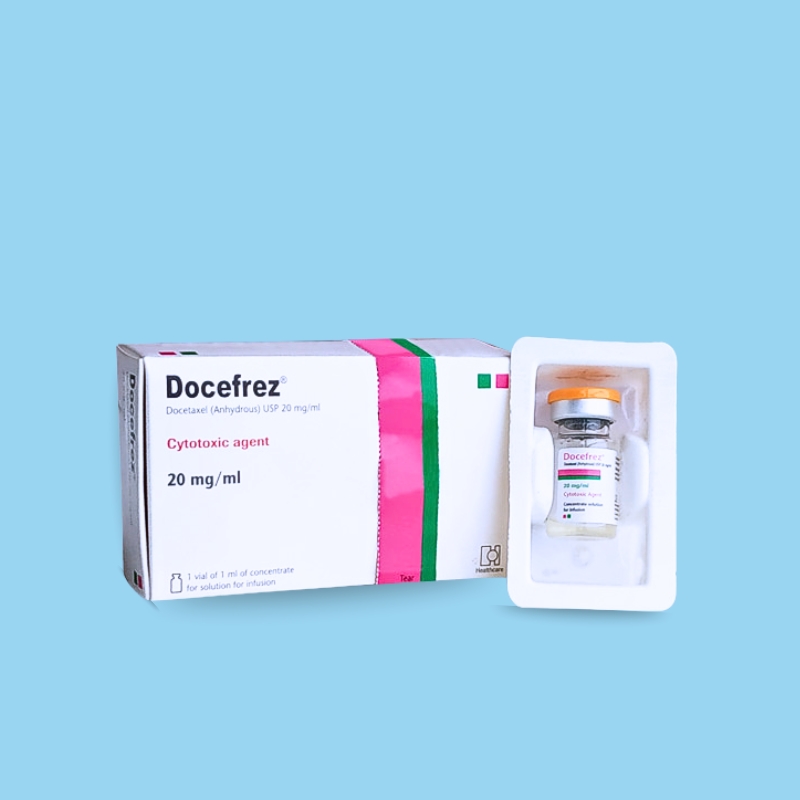
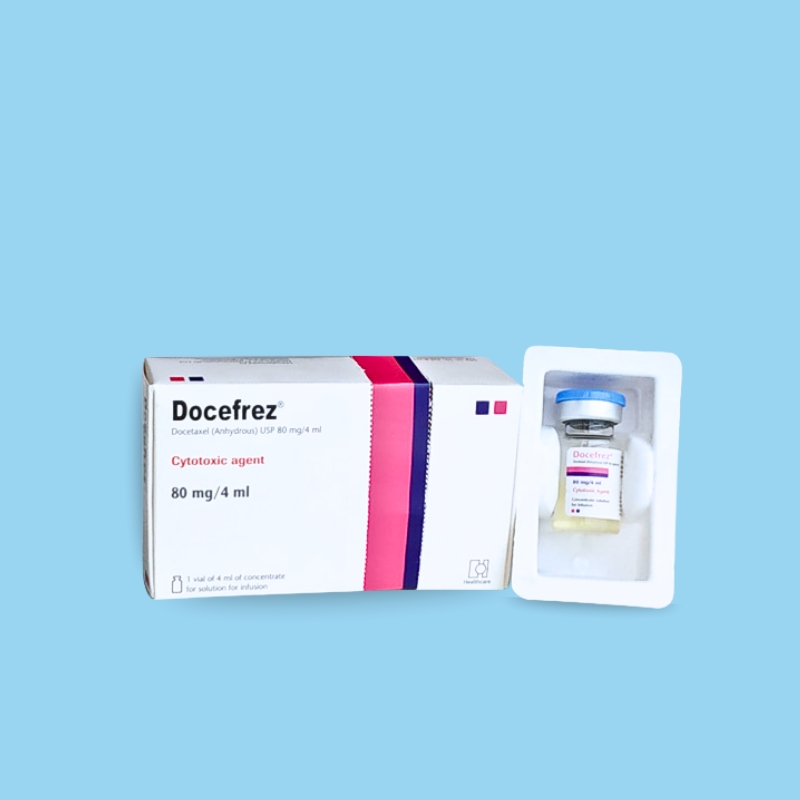
Docetaxel Injection is a microtubule inhibitor indicated for
the treatment of:
Breast Cancer (BC): As a single agent for locally advanced
or metastatic breast cancer after chemotherapy failure; and with doxorubicin
and cyclophosphamide as adjuvant treatment of operable node-positive breast
cancer.
Non-Small Cell Lung Cancer (NSCLC): As a single agent for
locally advanced or metastatic NSCLC after platinum therapy failure; and with
cisplatin for unresectable, locally advanced or metastatic untreated NSCLC.
Hormone Refractory Prostate Cancer (HRPC): With prednisone
in androgen-independent (hormone refractory) metastatic prostate cancer.
Gastric Adenocarcinoma (GC): With cisplatin and fluorouracil
for untreated, advanced gastric cancer, including the gastroesophageal
junction.
Squamous Cell Carcinoma of the Head and Neck (SCCHN): With
cisplatin and fluorouracil for induction treatment of locally advanced SCCHN.
Docetaxel is a CYP3A4 substrate. Its metabolism may be
modified by concomitant administration of compounds that induce, inhibit, or
are metabolized by CYP3A4. In vivo studies showed that docetaxel exposure
increased 2.2-fold when co-administered with ketoconazole, a potent CYP3A4
inhibitor.
Docetaxel Injection should be administered in a facility
equipped to manage possible complications (e.g., anaphylaxis). Administer
intravenously over 1 hour every 3 weeks. PVC equipment is not recommended.
Breast Cancer (locally advanced or metastatic): 60–100 mg/m²
as a single agent.
Breast Cancer (adjuvant): 75 mg/m² administered 1 hour after
doxorubicin 50 mg/m² and cyclophosphamide 500 mg/m² every 3 weeks for 6 cycles.
NSCLC (chemotherapy-naive): 75 mg/m² followed by cisplatin
75 mg/m².
HRPC: 75 mg/m² with 5 mg prednisone twice daily continuously.
Gastric Cancer: 75 mg/m² followed by cisplatin 75 mg/m²
(both on day 1 only), then fluorouracil 750 mg/m² per day as a 24-hour infusion
(days 1–5).
SCCHN (induction):
Regimen 1: 75 mg/m² + cisplatin 75 mg/m² (day 1) + fluorouracil 750 mg/m² per
day as 24-hour infusion (days 1–5), for 4 cycles.
Regimen 2: 75 mg/m² + cisplatin 100 mg/m² (day 1) +
fluorouracil 1000 mg/m² per day as 24-hour infusion (days 1–4), for 3 cycles.
Special Instructions: Premedicate with oral corticosteroids.
Adjust dose as needed. Follow proper procedures for handling and disposal of
anticancer drugs.
Severe hypersensitivity to docetaxel.
Neutrophil counts <1500 cells/mm³.
Common: Infections, neutropenia, anemia, febrile
neutropenia, hypersensitivity, thrombocytopenia, neuropathy, dysgeusia,
dyspnea, constipation, anorexia, nail disorders, fluid retention, asthenia,
pain, nausea, diarrhea, vomiting, mucositis, alopecia, skin reactions, myalgia.
Rare: Pulmonary edema, hypertension, fatal anaphylaxis.
Pregnancy: Category D. Docetaxel can cause fetal harm when
administered to a pregnant woman.
Lactation: It is not known whether docetaxel is excreted in
human milk. Discontinue nursing if treatment is necessary.
Hepatic Impairment: Patients with combined abnormalities of
transaminases and alkaline phosphatase should not be treated.
Acute myeloid leukemia: Monitor for delayed myelodysplasia
or leukemia when combined with doxorubicin and cyclophosphamide.
Cutaneous reactions: Erythema with edema and desquamation
may occur; severe cases may require dose adjustment.
Neurologic reactions: Paresthesia, dysesthesia, and pain may
occur; severe persistent cases require discontinuation.
Asthenia: Severe cases may require discontinuation.
Pregnancy: Women of childbearing potential should avoid
pregnancy while receiving docetaxel.
There is no known antidote for docetaxel overdosage. In case
of overdose, patients should be kept in a specialized unit where vital
functions can be closely monitored.
Store at a temperature not exceeding 25°C in a dry place. Do
not freeze. Protect from light.