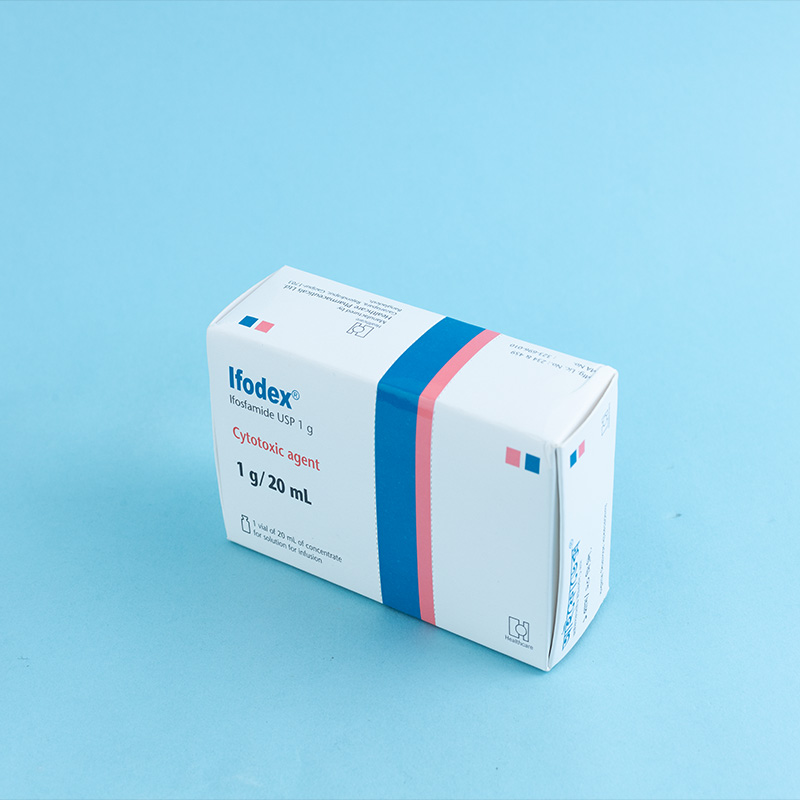
Ifosfamide Injection is indicated for use in combination
with certain other approved antineoplastic agents for third-line chemotherapy
of germ cell testicular cancer. It should be used in combination with mesna for
prophylaxis of hemorrhagic cystitis.
Ifosfamide is a substrate for both CYP3A4 and CYP2B6.
CYP3A4 inducers (e.g., carbamazepine, phenytoin,
fosphenytoin, phenobarbital, rifampin, St. John’s Wort) may increase metabolism
of Ifosfamide to its active alkylating metabolites and increase formation of
the neurotoxic/nephrotoxic metabolite chloroacetaldehyde. Closely monitor
patients for toxicities and consider dose adjustment.
CYP3A4 inhibitors (e.g., ketoconazole, fluconazole, itraconazole,
sorafenib, aprepitant, fosaprepitant, grapefruit juice) may decrease the
metabolism of Ifosfamide to its active alkylating metabolites, possibly
decreasing effectiveness.
Ifosfamide should be administered intravenously at a dose of
1.2 g/m² per day for 5 consecutive days. Treatment is repeated every 3 weeks or
after recovery from hematologic toxicity (Platelets ≥100,000/mL, WBC
≥4,000/mL).
To prevent bladder toxicity, Ifosfamide should be given with
extensive hydration consisting of at least 2 liters of oral or intravenous
fluid per day. A protector such as Mesna should also be used to prevent
hemorrhagic cystitis.
Ifosfamide should be administered as a slow intravenous
infusion lasting a minimum of 30 minutes. Although Ifosfamide has been
administered to a small number of patients with compromised hepatic and/or
renal function, studies to establish optimal dose schedules in such patients
have not been conducted.
Ifosfamide is contraindicated in patients with known
hypersensitivity to ifosfamide and in patients with urinary outflow
obstruction.
Adverse reactions and frequencies are based on 30
publications describing clinical experience with fractionated administration of
Ifosfamide as monotherapy with a total dose of 4 to 12 g/m² per course. Because
clinical trials are conducted under widely varying conditions, adverse reaction
rates cannot be directly compared and may not reflect rates observed in
clinical practice.
Pregnancy: Category D. Ifosfamide can cause fetal harm when
administered to a pregnant woman. Fetal growth retardation and neonatal anemia
have been reported following exposure to ifosfamide-containing regimens during
pregnancy. Animal studies indicate gene mutations and chromosomal damage in
vivo.
Women should not become pregnant and men should not father a
child during therapy and for up to 6 months after therapy.
Nursing Mothers: Ifosfamide is excreted in breast milk.
Women must not breastfeed during treatment.
Pediatric Use: Safety and effectiveness have not been
established.
Geriatric Use: Use cautiously, reflecting reduced organ
function and comorbidities. Half-life may increase with age. Monitor renal
function carefully.
Renal Impairment: Ifosfamide and metabolites are
substantially excreted by the kidney; patients with renal impairment may have
greater risk of toxicity.
Myelosuppression & Immunosuppression: Ifosfamide may
cause severe leukopenia, neutropenia, thrombocytopenia, and anemia, increasing
risk of life-threatening infections and sepsis. Monitor CBC regularly.
CNS Toxicity: Neurotoxicity such as confusion,
hallucinations, seizures, somnolence, and coma have been reported. Symptoms
usually resolve within 48–72 hours of discontinuation but may persist.
Discontinue if encephalopathy develops.
Renal & Urothelial Toxicity: Ifosfamide is both
nephrotoxic and urotoxic. Hydration and mesna co-administration are essential.
Fertility: Ifosfamide can cause amenorrhea, azoospermia, and
sterility in both sexes.
Overdose may cause enhanced toxicities including severe
myelosuppression, neurotoxicity, and urotoxicity. Supportive and symptomatic
treatment should be provided. There is no specific antidote.
Store the vial in the original carton at 2°–8°C. Protect
from light. Keep out of reach of children.