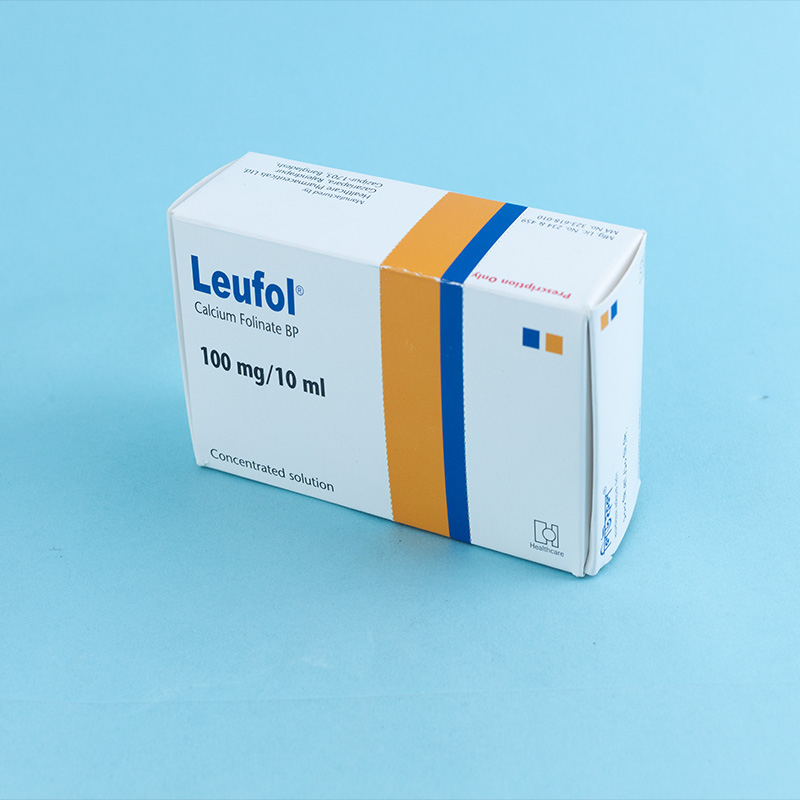
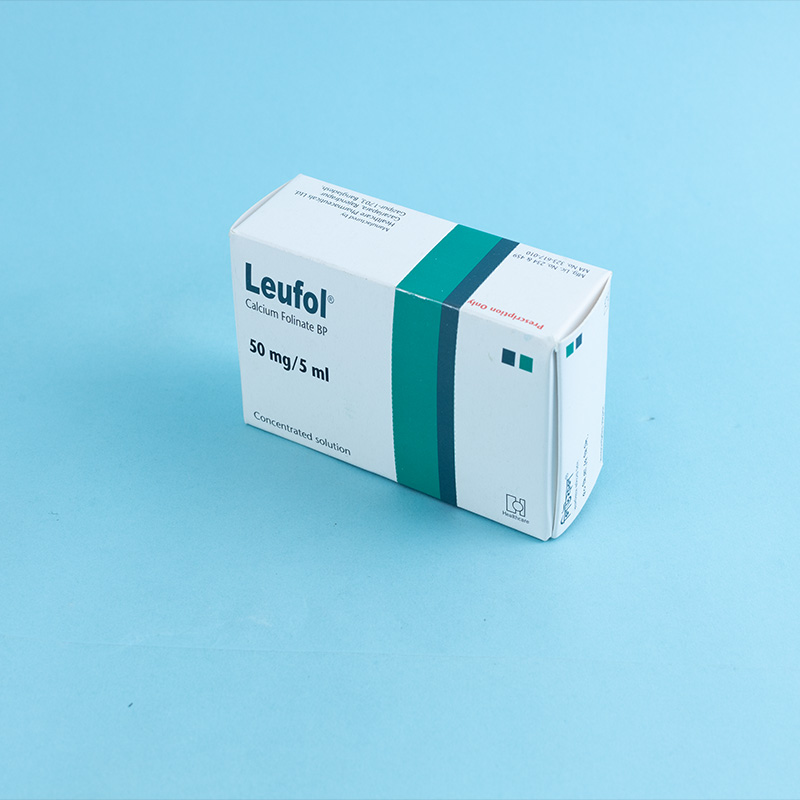
Calcium folinate is indicated to diminish the toxicity and
counteract the effect of impaired methotrexate elimination. It is used to treat
inadvertent overdosage of folic acid antagonists and after high-dose
methotrexate therapy in osteosarcoma. It is indicated to treat megaloblastic
anemia due to folic acid deficiency, megaloblastic anemia of pregnancy and
infancy, and for use in combination with 5-fluorouracil to prolong survival in
the palliative treatment of patients with advanced colorectal cancer.
Folic acid in large amounts may counteract the antiepileptic
effect of phenobarbital, phenytoin, and primidone.
Advanced Colorectal Cancer: Either of the following two
regimens is recommended:
i) Administration of 200 mg/m² by slow intravenous injection
over a minimum of 3 minutes, followed by 5-fluorouracil at 370 mg/m² by
intravenous injection.
ii) Administration of 20 mg/m² by intravenous injection
followed by 5-fluorouracil at 425 mg/m² by intravenous injection.
5-Fluorouracil and Calcium folinate should be administered
separately to avoid the formation of a precipitate. Treatment is repeated daily
for 5 days. This 5-day treatment course may be repeated at 4-week (28-day)
intervals for 2 courses and then repeated at 4 to 5-week (28 to 35 day)
intervals provided that the patient has completely recovered from the toxic
effects of the prior treatment course.
High-Dose Methotrexate Therapy: The recommendations for
Calcium folinate rescue are based on a methotrexate dose of 12 to 15 grams/m²
administered by IV infusion over 4 hours. Calcium folinate rescue at a dose of
15 mg (approximately 10 mg/m²) every 6 hours for 10 doses starts 24 hours after
the beginning of the methotrexate infusion. Calcium folinate administration,
hydration, and urinary alkalization (pH of 7.0 or greater) should be continued
until the methotrexate level is below 5 x 10⁻⁸ M (0.05 µM). Calcium folinate
dose should be adjusted or rescue extended based on methotrexate elimination
status.
Impaired Methotrexate Elimination or Inadvertent Overdosage:
Calcium folinate 10 mg/m² should be administered by IV/IM every 6 hours until
the serum methotrexate level is less than 10⁻⁸ M. Serum creatinine and
methotrexate levels should be determined at 24-hour intervals. If the 24-hour
serum creatinine has increased 50% over baseline or if the 24-hour methotrexate
level is greater than 5 x 10⁻⁶ M or the 48-hour level is greater than 9 x 10⁻⁷
M, the dose of Calcium folinate should be increased to 100 mg/m² IV every 3
hours until the methotrexate level is less than 10⁻⁸ M.
Megaloblastic Anemia Due to Folic Acid Deficiency: Up to 1
mg daily.
Method of Administration: Calcium folinate is administered
intravenously (IV) or intramuscularly (IM). Reconstitute with Bacteriostatic
Water for Injection, USP, which contains benzyl alcohol, or with Sterile Water
for Injection, USP.
Calcium folinate is contraindicated in patients with known
hypersensitivity to the active substance or to any of the excipients. It is
contraindicated in pernicious anemia and other megaloblastic anemias secondary
to the lack of vitamin B12.
Common side effects include nausea, vomiting, diarrhea, and
hand-foot syndrome. Rare side effects include seizures and syncope.
Pregnancy: Pregnancy Category C.
Nursing Mothers: Not recommended.
In the treatment of accidental overdosages of folic acid
antagonists, intravenous Calcium folinate should be administered as promptly as
possible. Calcium folinate may be harmful or fatal if given intrathecally.
Monitoring of the serum methotrexate concentration is essential in determining
the optimal dose and duration of treatment with Calcium folinate. When doses
greater than 10 mg/m² are administered, Calcium folinate for injection should
be reconstituted with sterile water for injection, USP and used immediately. In
very rare cases, sloughing of the skin, rarely leading to death, has been
reported in patients receiving Calcium folinate along with other medications
known to have similar side-effects. No more than 160 mg/min of Calcium folinate
should be injected intravenously. When Calcium folinate and 5-fluorouracil are
administered concurrently in the palliative therapy of advanced colorectal
cancer, the dosage of 5-fluorouracil must be lower than usually administered to
avoid gastrointestinal toxicities. Calcium folinate/5-fluorouracil combination
therapy for advanced colorectal cancer should be administered under the
supervision of a physician experienced in the use of antimetabolite cancer
chemotherapy. Particular care should be taken in the treatment of elderly or debilitated
colorectal cancer patients, as these patients may be at increased risk of
severe toxicity.
Excessive amounts of Calcium folinate may nullify the chemotherapeutic effect of folic acid antagonists.
Store in a refrigerator at 2–8°C. Protect from light. Keep
out of the reach of children.