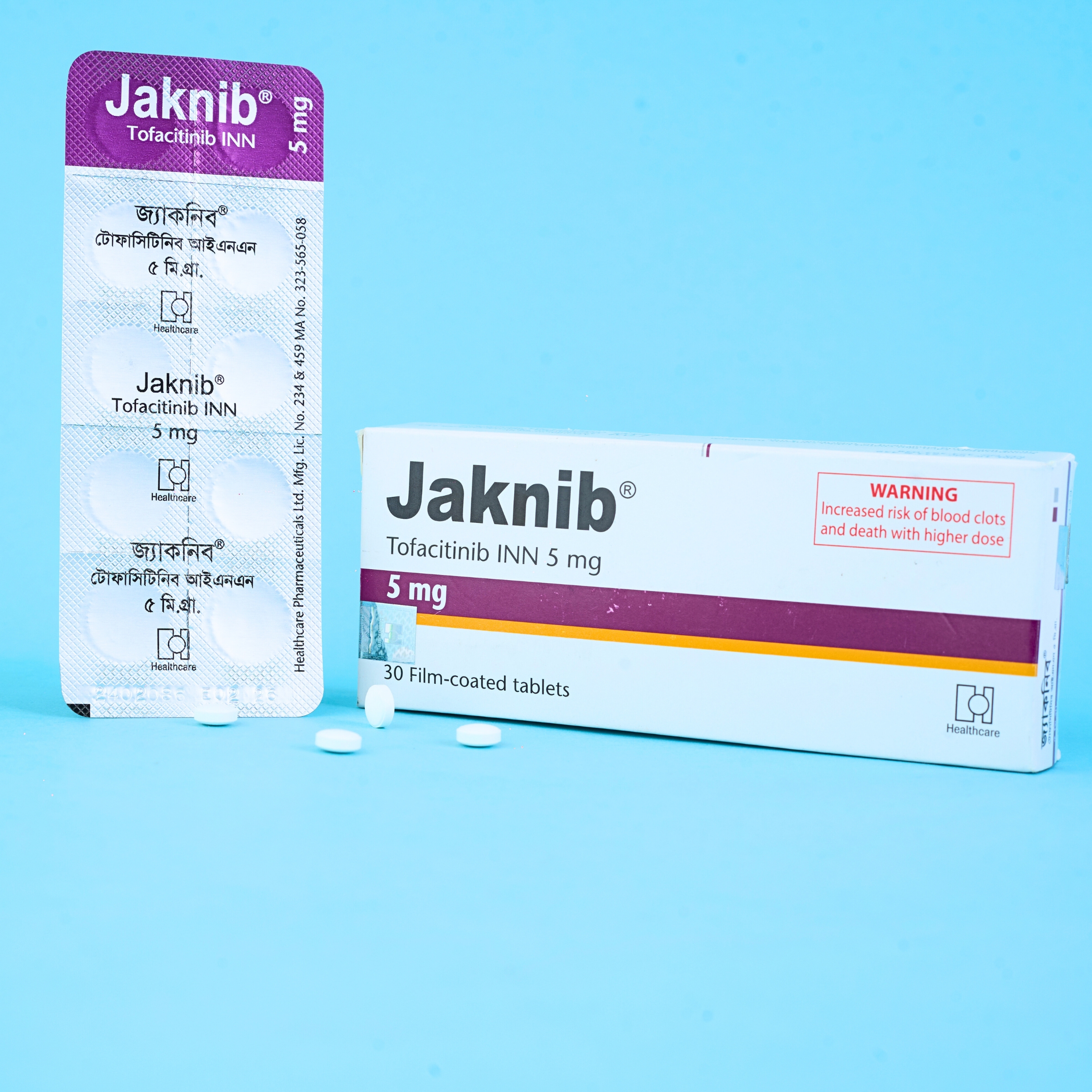
Rheumatoid Arthritis: Jaknib is indicated for the treatment
of adult patients with moderately to severely active rheumatoid arthritis who
have had an inadequate response or intolerance to methotrexate. It may be used
as monotherapy or in combination with methotrexate or other nonbiologic
disease-modifying antirheumatic drugs (DMARDs).
Psoriatic Arthritis: Jaknib is indicated for the treatment
of adult patients with active psoriatic arthritis who have had an inadequate
response or intolerance to methotrexate or other disease-modifying
antirheumatic drugs (DMARDs).
Ulcerative Colitis: Jaknib is indicated for the treatment of
adult patients with moderately to severely active ulcerative colitis (UC).
Potent inhibitors of Cytochrome P450 3A4 (CYP3A4) (e.g.,
Ketoconazole)
Recommended dose is Jaknib 5 mg once daily: One or more
concomitant medications that result in both moderate inhibition of CYP3A4 and
potent inhibition of CYP2C19 (e.g., fluconazole)
Recommended dose is Jaknib 5 mg once daily Potent CYP
inducers (e.g.Rifampin): May result in loss of or reduced clinical response.
Rheumatoid Arthritis: Tofacitinib 5 mg twice daily or
Tofacitinib 11 mg once daily. Recommended dosage in patients with moderate and
severe renal impairment or moderate hepatic impairment is Tofacitinib 5 mg once
daily.
Psoriatic Arthritis (in combination with nonbiologic
DMARDs): Tofacitinib 5 mg twice daily or Tofacitinib 11 mg once daily. Recommended dosage in patients with moderate
and severe renal impairment or moderate hepatic impairment is Tofacitinib 5 mg
once daily.
Ulcerative Colitis: Tofacitinib 10 mg twice daily for at
least 8 weeks; then 5 or 10 mg twice daily. Discontinue after 16 weeks of 10 mg
twice daily, if adequate therapeutic benefit is not achieved. Use the lowest
effective dose to maintain response.
The most commonly reported adverse reactions during the
first 3 months in controlled clinical trials (occurring in greater than or
equal to 2% of patients treated with Jaknib monotherapy or in combination with
DMARDs) were upper respiratory tract infections, headache, diarrhea and
nasopharyngitis.
Pregnancy Category C. There are no adequate and well
controlled studies in pregnant women. Tofacitinib should be used during
pregnancy only if the potential benefit justifies the potential risk to the
fetus.
It is not known whether Tofacitinib is excreted in human
milk. Because many drugs are excreted in human milk and because of the
potential for serious adverse reactions in nursing infants from Tofacitinib, a
decision should be made whether to discontinue nursing or to discontinue the
drug, taking into account the importance of the drug for the mother
Serious Infections: Avoid use of Jaknib during an active
serious infection, including localized infections.
Gastrointestinal Perforations: Use with caution in patients
that may be at increased risk.
Laboratory Monitoring: Recommended due to potential changes
in lymphocytes, neutrophils, hemoglobin, liver enzymes and lipids.
Immunizations: Live vaccines: Avoid use with Jaknib.
Do not initiate Jaknib if absolute lymphocyte count <500
cells/mm3, an absolute neutrophil count (ANC) <1000 cells/mm3 or hemoglobin
<9 gm/dL.
Use in Special Populations
Pediatric Use: The safety and effectiveness of Jaknib in
pediatric patients have not been established.
Geriatric Use: The frequency of serious infection among
Jaknib-treated subjects 65 years of age and older was higher than among those
under the age of 65. As there is a higher incidence of infections in the
elderly population in general, caution should be used when treating the
elderly.
Moderate and severe renal impairment or moderate hepatic
impairment: half the total daily dosage recommended for patients with normal
renal and hepatic function.
There is no specific antidote for overdose with Tofacitinib.
In case of an overdose, it is recommended that the patient be monitored for signs and symptoms of adverse reactions.
Store below 30°C. Protect from light & moisture. Keep
all medicines out of the reach of children.